

Reservoir of Seasons
ecosystem
Kitchen Budapest
Budapest, Hungary
2008

Some people believe that global warming is just a fiction, but we know it is happening, because we feel it and we see it every day. Reservoir of Seasons is not about presenting phenomena which many people will never experience, like dying polar bears, melting icebergs or the cooling of the Gulf Stream, but about the subtle changes we experience every day.


Reservoir of Seasons from Gina Haraszti on Vimeo.

More extreme weather or less moderate weather?
A result of climate change that we can notice on a local level is the gradual disappearance of moderate seasons of weather, longer periods of extreme weather, birds migrating too soon or too late and a change in the planting and harvesting of crops.

Due to its geographical location, Hungary has a moderate continental climate and extreme weather is rare. Yet these changes are being felt in Hungary and in similar climates that can be found around the world in places such as the Balkan Peninsula , North America and north east China.


Built to scale
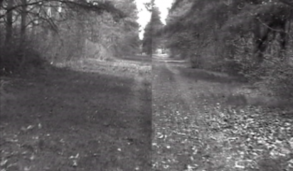
Reservoir of Seasons aims to recreate the conditions found in nature in a controlled environment that is independent from its surroundings. The sphere is a scale model of a much larger environment that is intended to function as a balanced ecosystem of plants and animals, with an adjustable climate. By adjusting the temperature, rainfall, humidity, wind speed, pressure or other climate factors it is possible to create an environment that, in our case, represents spring or autumn.

In autumn the temperature is dropping, we think of fog and the smell of damp leaves in the forest and the evenings cast long shadows with a golden brown light. During the spring months plants are growing, showers of rain give everything a fresh feeling; there is the smell of freshly cut grass and the sound of singing birds.

We can simulate weather but not indefinitely
In this simulation we used basic electronics components including fans, light bulbs, water pumps, ultrasonic misters, speakers and a Peltier junction; as well as a control system implemented on a laptop. This allows the environment to shift from spring to autumn.

Reservoir of Seasons is not a self-sustaining environment; it requires outside light and electricity, people to maintain it and the components won’t work indefinitely. However it gives us some insight into the greater problems facing the planet.

While the environment is difficult to model and even more difficult to mange, but it can be understood. However without these seasonal cues, the long term effects on a given society’s political, artistic, and emotional well being as well as the effects on its traditions can’t be simulated.

There is no easy solution to the challenges we face, but being aware of them is the first step.

Collaborators:
Györgyi Gálik, Juhász Márton, John Nussey

ATTAKK
bluetooth installation
Műcsarnok
Budapest, Hungary
2007

ATTAKK is a bluejacking installation which was presented in Hungarian Arthall at exhibition !REVOLUTION?. Visitors were spammed by an unsolicited mobile phone media messages (bluejacking). The message arrives in the form of a picture, video or a sound file representing major turning points in 20th century Hungarian history. ATTAKK attacks the visitors reminding them the aspirations, passions and distresses that form the background of these historical turning points.
Technical adviser: Bengt Sjölen
Collaborator: Lena Kutuvolgyi

Separating Fusion

video performance
Hungarian Culture Institution - Gallery U
Helsinki, Finland
2007

Finno-Ugrian Interchange
Collaborator: Salla Rautiainen
A long time ago the Finns and the Hungarians used to speak the same language, called ancient Finno-Ugrian. But they aren’t able to communicate with each other anymore using Finnish and Hungarian terms.

What happens when a young Hungarian artist meets a young Finnish one and they start working together in order to find a language they both speak?

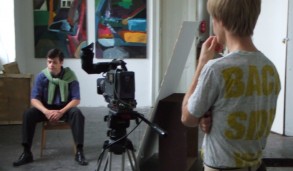
During the video-performance, “Separating Fusion,” Gina Haraszti and Salla Rautiainen are sitting in arm-chairs in a stylized enviroment, which imitates a home. They face their own video works, projected into drawn televisions. An audiance gathers on a fake carpet and they use specially prepared remotes to control the videos. The two artists are controlling their own videos but sometimes they try to affect each other’s or the audience’s viewing.

During the three days of the performance, the videos are mixing together more and more and finally they become self-controlling.

Stuttgarter Videostickers
intermedial installation
Württembergischer Kunstverein
Stuttgart, Germany
2006

The project Stuttgarter VideoStickers lets the viewer discover hidden layers of the city and shows the influence of major sport and cultural events as the “City Spectacle” workshop in the urban landscape.

The project uses videos as a way to link artistic messages to certain locations, which explore the mechanisms and the effects of spectacularization of cultural and social life in the city.
VideoStickers is an international public art project which can be read as an expansion of Lefebvre’s notions which he developed in ‘The Production of Space’.

The basics for the project are stickers, a video blog (vlog) and the urban environment. I placed uniquely coded stickers and shot videos at the same place than uploaded the videos and the places og the stickers to the vlog-map.
The video messages range from historical context and developing the image of the city (tourism, social life, etc.) to events that impact on me personally, during the workshop, like the unexpected political events in Hungary that occur during the workshop.

Collaborator: Lena Kutuvolgyi